Gamification for customer service teams: what works and what backfires
Points and leaderboards can make a busy inbox more fun, or turn your team into ticket-closing machines that annoy customers. Here’s what tends to backfire, what works instead, and how we built Colvy Powers around it.

The idea is simple and old: make repetitive work feel a little more like a game, and people enjoy it more. Points for answering customers. A level to climb. A bit of friendly competition.
Done well, it gives a busy team something to smile about and a reason to notice each other's good work. Done badly, you get people racing to close conversations before they're finished, customers getting three short replies where one good one would do, and the quiet person handling the hardest calls sitting at the bottom of a public ranking every week.
Here's what tends to go wrong, what to do instead, and how those rules shaped Colvy Powers.
Why gamification backfires
It rewards activity instead of outcomes
If every message earns a point, you'll get more messages. Shorter ones, split into three, with less in each. If closing a conversation earns a point, conversations get closed before the customer's problem is actually fixed. People aren't being sneaky. They're doing exactly what the scoreboard asks.
Speed becomes the only score
A race for the fastest reply sounds harmless. In practice it pushes people to grab the easy conversations and leave the tricky refund for someone else. The customer with the hardest problem waits longest.
Public rankings sting
Whoever's at the bottom of the leaderboard is often the person on the phones with the angriest customers, or the one who works three days a week. Ranking them in front of everyone tells them their work doesn't count.
The stakes get too high
Tie points to cash, time off or shifts, and a game turns into a pay dispute. Every rule becomes something to argue about, and every loophole gets found.
It gets in the way
Pop-ups, sounds and badges sitting on top of the inbox slow down the very work they're meant to reward.
It's easy to farm
If an "ok 👍" earns the same as a proper answer, the team will notice within a day. After that, the points mean nothing.
What works instead
| Backfires | Works instead |
|---|---|
| Points for every message or click | Points for finished work a customer would notice |
| No ceiling | A daily limit per person |
| One person wins | Team goals that pay everyone who helped |
| A ranking everyone has to be in | A leaderboard you can show, reduce to team totals, or switch off |
| Cash, perks or time off | Playful rewards with no real-world value |
| Effects on top of the work | Small moments in the corner that can be dismissed |
1. Reward the work, not the busyness
Count things that mean a customer was actually helped. In Colvy Powers, resolving a conversation pays more than replying to one, and a resolve only counts after a real reply from you. Reopening and closing again doesn't pay twice.
The busywork doesn't count at all: one-word replies, internal notes and AI replies don't earn anything. A call has to be picked up and last at least 20 seconds, and voicemails don't count. A task you made for yourself and ticked off within ten minutes doesn't count either. If the work is undone, like a task that's reopened or an order that's cancelled, the reward is taken back.
2. Put a ceiling on it
A daily limit keeps it a game. Without one, the person who treats it like a second job runs away with it and everyone else stops caring. Colvy Powers caps each person at 150 coins and 300 XP a day by default, and busy rules have their own limits too, like up to 50 replies a day.
3. Make the team the unit
The best moments are shared ones. In Colvy Powers, a whole-team challenge pays everyone who helped when the team hits the target, so nobody has to beat a colleague to win. And when someone says thanks to a teammate, the teammate earns the reward, not the person saying it.
4. Let people choose how public it is
Some teams love a podium. Many don't. A good system lets you choose.
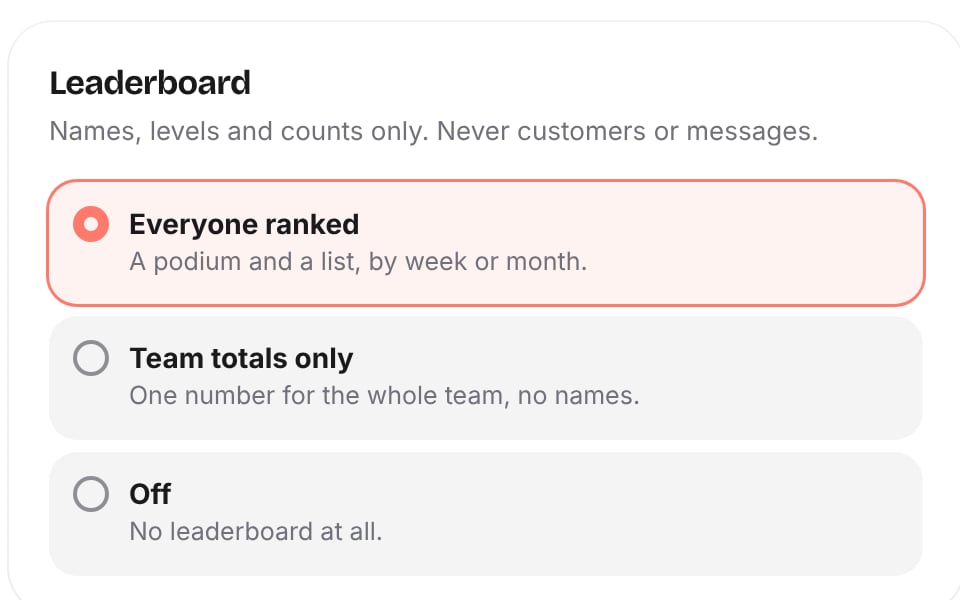
Colvy Powers has three settings: everyone ranked, team totals only (one number for the whole team, no names), or off. Whichever you pick, the leaderboard shows names, levels and counts only, never customers or messages.
5. Keep the prizes playful
The moment points are worth real money, people stop playing and start negotiating. Colvy Coins can't be bought, cashed out or moved to another workspace. They buy things like confetti on the team's screen, a small crown next to your name, or a spotlight on a teammate's great work. Levels and badges unlock looks only, never access or permissions.
6. Never block the work
Customers come first, always. In Colvy Powers, playful moments sit in the corner of the screen and can be dismissed. Anyone can put up a Focus Shield for 30 quiet minutes without nudges or confetti, and customer messages and real alerts still come straight through.

7. Start everyone level
Switching on rewards shouldn't hand out a windfall for last month's work. Colvy Powers is off until an owner or admin turns it on, and work done before then never pays, so everyone starts from zero on the same day.
A quick test before you start
For each thing your system rewards, ask: if someone did the best possible thing for a customer here, would they earn more, or less?
If a careful 20-minute fix earns less than ten quick "thanks!" replies, change the rule. If closing early beats solving properly, change the rule. If one person can win by working through lunch every day, add a limit.

Where to go from here
If you'd like to try it, our guide to setting up Colvy Powers walks through every setting, and these team challenge ideas point the team at things customers will feel.
Start free and switch on Colvy Powers when your team's ready.
Key takeaways
- Reward finished work a customer would notice, not activity like clicks, one-word replies or time with a tab open.
- Put a ceiling on it. A daily limit stops anyone farming points and keeps it a game, not a second job.
- Make rankings optional. Team totals, or no leaderboard at all, suit plenty of teams better than a podium.
- Keep the prizes playful and the stakes low: no cash, no perks at work, and nothing that ever gets between you and a customer.
Bring every conversation into one inbox
Messages, calls, reviews and feedback — all in Colvy. Start free.
Get started free